



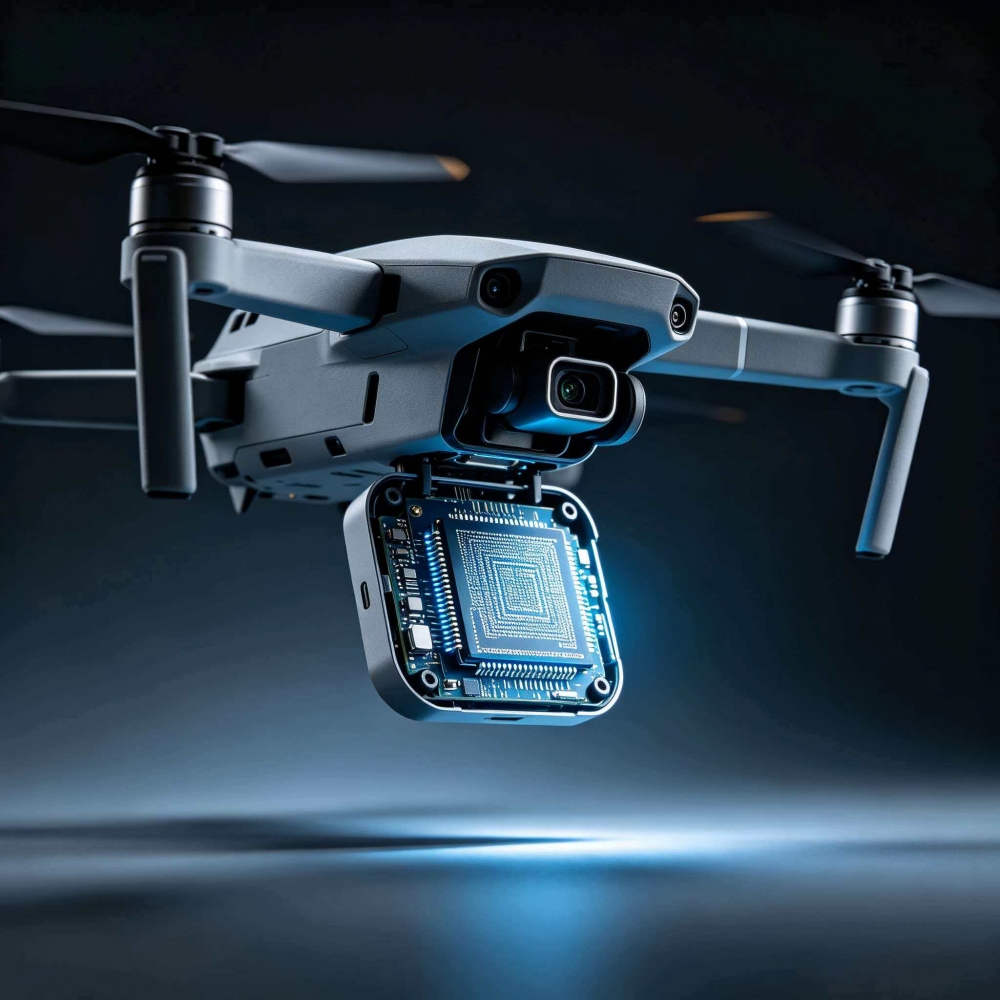

Classification and Features of Mainstream Core Chips
1. STM32 Series
This is the most widely used 32-bit ARM architecture microcontroller in the flight control field, covering all application scenarios from entry-level to high-end:
Entry-level: STM32F103, 72 MHz clock speed, rich peripheral interfaces, suitable for low-cost, small drone development
Intermediate Level: STM32F4 Series, 168 MHz clock speed, equipped with a hardware floating-point unit, capable of smoothly running complex flight control algorithms such as PID and Kalman filtering
High-End Level: STM32H743, 480 MHz clock speed, supports double-precision floating-point operations, with an interrupt response time of just 6 μs, meeting the high real-time requirements of industrial-grade drones
2.Cost-Effective Domestic MCUs
Represented by the Yateli AT32 series, these have become a popular choice in the flight control field in recent years:
AT32F435: 288MHz clock speed, equipped with a Cortex-M4F core, supports up to 4032KB of Flash and 512KB of SRAM, and can reliably drive components such as high-definition video transmission modules, IMUs, and GPS devices, making it suitable for industrial applications such as aerial photography and inspection
AT32F421: With a 120 MHz clock speed and compact form factor, this MCU is optimized for electronic control applications and is widely used in drone ESC control to achieve precise motor speed regulation
3.Classic Open-Source Solution Chips
AVR ATmega2560: An 8-bit microcontroller and the main controller for the classic APM 2.8 open-source flight controller. Through years of algorithm optimization, it enables stable flight at an extremely low cost, making it suitable for entry-level maker projects. The overall solution cost is more than 60% lower than that of 32-bit solutions.
RP2040: With a 133 MHz clock speed and support for custom D-Shot ESC signals, this chip is widely used in lightweight racing drones thanks to its low-power characteristics.
4.Dedicated High-Performance Chips
Some high-end flight controllers also incorporate FPGA and DSP chips for parallel processing of tasks such as image recognition and high-speed data filtering, further enhancing flight performance in complex scenarios.



 131-2899-0370

 2899280091
 xilinx@casi-ic.com
 Elan Tsao